Week 13, Interaction Design in Practice

Overview

Interaction design in practice involves primarily two things, Lean and Agile UX. Both having their own distinctive advantages over one another. Agile UX better takes advantage of user input before a design is finalized, allowing for instant changes as needed. Lean UX on the other hand, provides a finished product on release, allowing for users to get the full experience immediately.

Reflection

Marcin Treder states that the differences between Lean and Agile UX are profound as “Lean UX expresses important thoughts about processes, that weren’t clearly defined and named before. ” As he puts it in more detail, lean UX is used to form a cycle of building, measuring, and then learning in order to provide a final product.

My Thoughts

Personally I find Lean UX to be the more favorable of the two. As a consumer, I would want the complete package given to me with just the developer’s vision in mind. It might cause issues for some people but it seems far more respectable to provide a finished product to the users and during the course of production you release information. Said information could be used to help fine tune things.

References

Sharp, H., Preece, J., & Rogers, Y. (2015). Interaction Design: Beyond Human – Computer Interaction (4rth ed.). Wiley.

Treder, M. (2018, June 18). Lean UX vs. Agile UX – is there a difference? Retrieved April 20, 2019, from https://www.uxpin.com/studio/blog/lean-ux-vs-agile-ux-is-there-a-difference/
Week 12, Design, Prototyping, and Construction

Overview

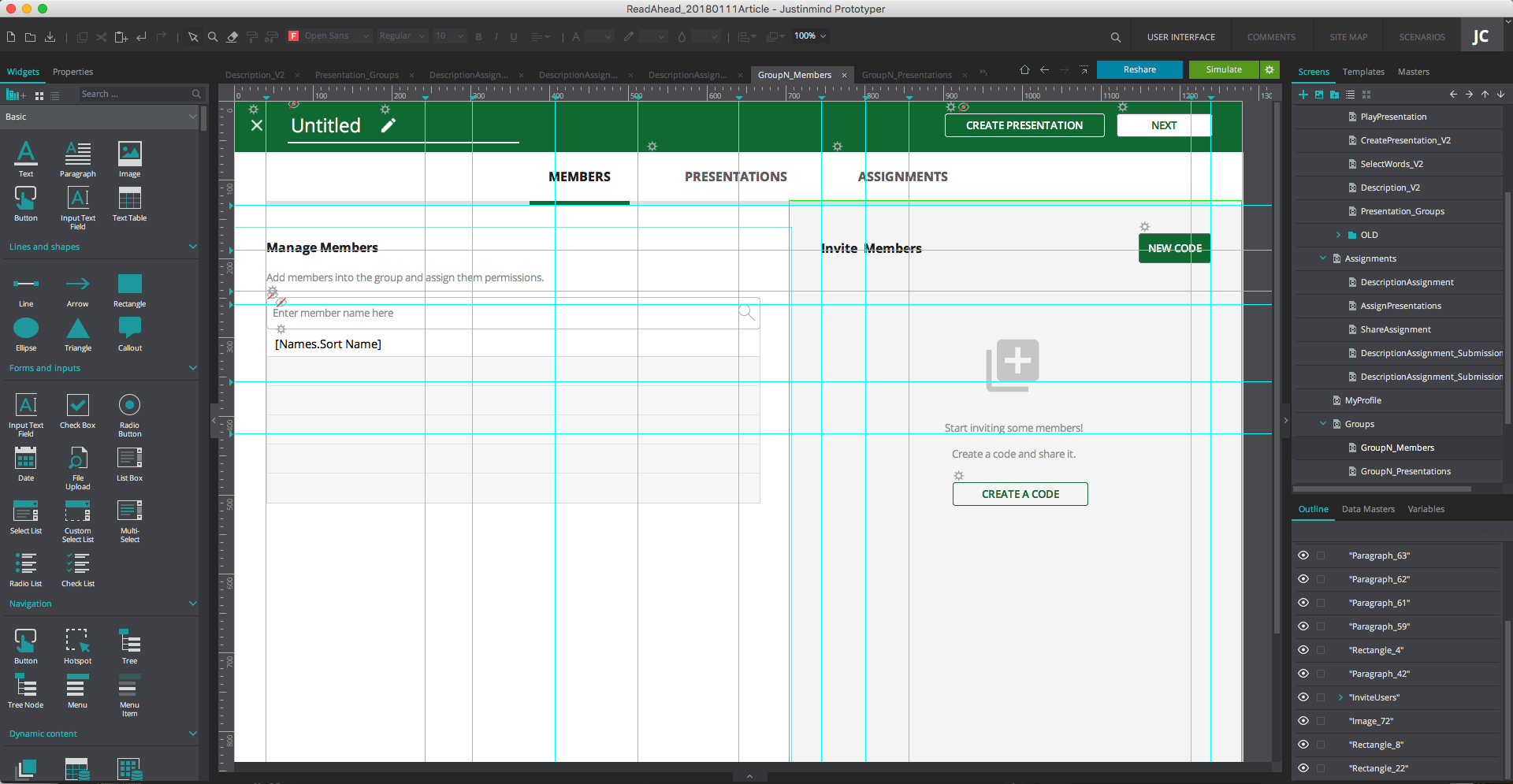
As stated by the book, prototypes are important to have a starting point and to show a proof of concept to stakeholders. It is also used as a showcase for alternative options, allowing for designers to make a more informed decision on what option they might want to pursue more.

Reflection

As Judit Casacuberta covers in her article, there are steps to take when prototyping any design. First a conceptual idea of the system must be possible. She also covers the course of prototypes being thrown out and redone. Which is fairly common as what was initially thought up, may not be the best answer to what’s trying to be solved or designed around.

My Thoughts

Prototyping is something that is of the upmost importance for creating anything new that I don’t think enough people take advantage of. Without some sort of initial frame to start off from and find out all the failures of the first draft, it can cause unnecessary grief for those using the product if its first design is thrown out to the public before any proper testing.

References

Sharp, H., Preece, J., & Rogers, Y. (2015). Interaction Design: Beyond Human – Computer Interaction (4rth ed.). Wiley.

Casacuberta, J. (n.d.). Perfect Your UX Design Process – A Guide to Prototype Design. Retrieved April 20, 2019, from https://www.toptal.com/designers/prototyping/guide-to-prototype-design

Week 11, Establishing Requirements

Overview

Getting something right the first time is incredibly important in reducing later costs from having to fix errors late in the development cycle as the book puts it. It states what a product should be doing and allows for developers to better keep track of how their progress is going in order to end up at the finished product they want to make in the first place.

Reflection

Justin Mifsud restates much of what the book talks about. Requirements are set in order to announce what the design is supposed to accomplish. However, he also makes mention of the non-functional requirements such as availability, reliability, and serviceability.

My Thoughts

Knowing your requirements for any kind of project is a good thing to have. It will allow you to keep on track with certain objectives and allow you to maintain a sustainable work load as you continue to progress towards a final product.

References

Sharp, H., Preece, J., & Rogers, Y. (2015). Interaction Design: Beyond Human – Computer Interaction (4rth ed.). Wiley.

Mifsud, J. (2013, May 20). Requirements Gathering: A Step By Step Approach For A Better User Experience. Retrieved April 20, 2019, from https://usabilitygeek.com/requirements-gathering-user-experience-pt1/

Week 10, The Process of Interaction Design

Overview

To understand Interaction Design it is important to take a look at the four basic activities of Interaction Design; Establishing Requirements, Designing Alternatives, Prototyping, and Evaluating. Establishing requirements is to understand who you are designing for and what you intend to build. Designing alternatives is to create concepts that could be implemented in the final product. Prototyping involves designing an interactive product, an example being paper models that you can use to test the design before putting work into the actual product itself. Evaluating is to understand the result of your prototyping, seeing what about your final design could be changed for the better.

Reflection

As stated by Teo Siang, there are important actions to take when undergoing an interaction design project that is reflected by the text. Design strategies and prototypes being two critical things mentioned in his article.

My Thoughts

With interaction design, it is important to keep the user in mind when designing anything. Having the knowledge and understanding of how the process works is invaluable for anyone trying to design something akin to a phone’s user interface. After all, If the user can’t instinctively get use and understand what you’ve developed then you’ve failed to make a proper design.

References

Sharp, H., Preece, J., & Rogers, Y. (2015). Interaction Design: Beyond Human – Computer Interaction (4rth ed.). Wiley.

Siang, T. (2019, March 23). What is Interaction Design? Retrieved April 20, 2019, from https://www.interaction-design.org/literature/article/what-is-interaction-design

Week 9, Simple Qualitative Analysis

Overview

While gathering data, certain elements will begin to make re-occurrences and will eventually start forming a pattern. This will eventually lead to the categorization of qualitative analysis in three different ways; identifying recurring patterns and themes, categorizing data, and analyzing critical incidents. Which can all be used in different combinations.

Reflection

In Tim Smith’s words, qualitative analysis “uses subjective judgment based on non-quantifiable information, such as management expertise, industry cycles, strength of research and development and labor relation.” As he says, it looks at the specific qualities something has that cannot be put purely in numbers. This is primarily used when dealing with businesses for more than just profit. Understanding the employee morale and how well they function together is important.

My Thoughts

Understanding qualitative analysis is important to understand the internal structure of a business in the sense of how it works on the inside and how sustainable it is in the long run. Seeing more than just numbers will always lead to a better advantage when collecting data as it is used to understand the context of what data has been gathered.

References

Sharp, H., Preece, J., & Rogers, Y. (2015). Interaction Design: Beyond Human – Computer Interaction (4rth ed.). Wiley.

Smith, T. (2019, April 4). Qualitative Analysis. Retrieved April 20, 2019, from https://www.investopedia.com/terms/q/qualitativeanalysis.asp

Week 8 Blog, Data Gathering

Overview

There are three big ways in which one can collect data from a group. Those being stated in the text as; interviews, questionnaires, and observations. Interviews are a conversation with the intent to obtain information about one of the participating parties, and is better suited for smaller scale data gathering such as a one on one conversation. Questionnaires are similar to interviews as they can obtain information about a user through questioning them, but can better be used when working with large groups. Observations, as the name implies, gathers information by watching what the targeted group does instead of asking them directly. It can be implemented at any stage of data gathering.


Reflection

Customer feedback is an example Jonathan Toler, which can be considered a questionnaire. It asks users questions that be closed or open ended and can easily be sent out to a large amount of people.

My Thoughts

Data gathering is a slippery slope in today’s age. On one hand, there is user privacy to take into consideration. Very little people actually read through the terms and agreements before signing away. And in certain cases, it can be signing away your privacy for a company to be able to observe and track what you’re doing while using their site. On the other hand, data gathering is incredibly important for businesses to make educated moves that could very well benefit the users.

References

Sharp, H., Preece, J., & Rogers, Y. (2015). Interaction Design: Beyond Human – Computer Interaction (4rth ed.). Wiley.

Toler, J. (2017, June 27). THOUGHT LEADERSHIP SERIES: GATHERING DATA. Retrieved from https://www.kloecknermetals.com/blog/thought-leadership-series-gathering-data/

Week 7 Blog, Virtual Reality

Overview

Virtual reality is computer-generated graphical simulations that create the illusion of participation in a synthetic environment rather than external observation of such an environment according to the text. However, a more specific term to describe what is being generated by computer technology would be Virtual Environment.

Reflection

Using two split images that are played for both eyes in order to create the illusion of a three-dimensional space for the user to interact with. In terms of HCI, it brings a new way to interact with technology. Instead of seeing things projected on a flat screen, we are now able to better create three-dimensional spaces that we can interact with virtually.  

My Thoughts

I believe that in its current state. Virtual Reality is incredibly limited and has yet to truly be tapped into properly. The lack of development and the extreme barrier to entry in the form of the cost and the needed space to set up things properly, along with the disorienting nature of using VR with a lack of safety or warning to where you along with the removal of your special awareness to your surroundings makes it difficult to get into at the moment.

References

Sharp, H., Preece, J., & Rogers, Y. (2015). Interaction Design: Beyond Human – Computer Interaction (4rth ed.). Wiley.

Dredge, S. (2016, November 10). The complete guide to virtual reality – everything you need to get started. Retrieved from https://www.theguardian.com/technology/2016/nov/10/virtual-reality-guide-headsets-apps-games-vr

Rubin, P. (2018, November 9). The Wired Guide to Virtual Reality. Retrieved from https://www.wired.com/story/wired-guide-to-virtual-reality/

Week 6 Blog, Expressive Interfaces

Overview

Expressive design details the ways that a UI would successfully communicate its meaning to the user. This is done through things such as dynamic icons, animations, feed back from noises and vibrations. Such as when you tap a key on your phone, it is accompanied by a slight vibration and sometimes a clicking sound as well.

Reflection

A clear example of an expressive interface comes from a video game I’ve been playing recently, Persona 5. It’s menu systems are heavily stylized with flowing animations as you navigate the menus accompanied by audio feedback and a clear highlight as you go through each of the options. As stated by Camurri, Mazzarino and Volpe. “Analysis of expressiveness in human gesture can lead to new paradigms for the design of improved human-machine interfaces, thus enhancing users’ participation and experience in mixed reality applications and context-aware mediated environments.” Relating back to HCI using the Persona 5 UI example as evidence of this. The user’s participation is improved upon by having a fundamental aspect of the game being so finely tuned.

My Thoughts

Expressive designs are useful for all things. Given that we have to interact with it in some way or another. Having an object be easy to understand with what it’s trying to communicate to us makes designing something that would be considered expressive all the more important.

References

Sharp, H., Preece, J., & Rogers, Y. (2015). Interaction Design: Beyond Human – Computer Interaction (4rth ed.). Wiley.

Yates, N. J. (2017, May 16). Building Expressive Interfaces. Retrieved from https://medium.com/@nathanjy/building-expressive-interfaces-99424b47525d

Camurri, A., Mazzarino, B., & Volpe, G. (2003, December 19). Expressive Interfaces. Retrieved from https://link.springer.com/article/10.1007/s10111-003-0138-7

Henges, E. (2017, November 13). Atlus Details the Designs of Persona 5’s Unique UI. Retrieved from https://www.playstationlifestyle.net/2017/11/13/atlus-details-designs-persona-5s-unique-ui/

Week 5 Blog, Remote Conversations

Overview

Remote conversations have been apart of our lives ever since the invention of the telephone. A revolutionary concept, being able to contact someone across the world and be able to hold a conversation with them in real time without the delay of letters needing to be shipped overseas.

Reflection

Remote conversations allow for quick and easy communication across the world from anywhere that has a connection. And does have its advantages over meetings held in person to some extent. As put by Abigai J. Sellen. “Overall, only the same-room condition showed any significant differences from any other condition; people in the same room produced more interruptions and fewer formal handovers of the floor than in any of the technology-mediated conditions.” Meaning in terms of HCI, a remote conversation can lead to a better flowing meeting as one speaker moves to the next.

My Thoughts

Remote conversations, or a more modern take on it, virtual meetings. Are a quintessential part of modern life. It has allowed businesses to function all across the world and allowed citizens of different nations to talk to each other in real time without any hindrance. It would be difficult to find someone in today’s world that doesn’t have a friend that lives in another state or another country.

References

Sharp, H., Preece, J., & Rogers, Y. (2015). Interaction Design: Beyond Human – Computer Interaction (4rth ed.). Wiley.

Sellen, A. J. (2009, November 11). Remote Conversations: The Effects of Mediating Talk With Technology. Retrieved from https://www.tandfonline.com/doi/abs/10.1207/s15327051hci1004_2

Insider Virtual Management Tips To Engage Remote Employees Easily. (2017, December 13). Retrieved from https://businessfirstfamily.com/virtual-management-tips-engage-remote-employees/

Week 4 Blog, Cognition

Overview

Cognition is the process of the human mind to understand, learn and create thoughts. Examples that are also stated in text would be driving a car, reading a book, or having a conversation. These are all processes that are learned over time.

Reflection

Cognition relates to HCI in various ways. Given that we create new things and develop new UIs in products. We are eventually going to have to learn how to use new devices. This relates back to cognition as cognition is what allows us to learn. As stated by Kendra Cherry “As you take in sensations from the world around you, the information that you see, hear, taste and smell must first be transformed into signals that your brain can understand.” This would be similar to how we would first learn how to deal with a new product that differs from what we’re use to.

My Thoughts

Cognition plays possibly the largest role in human learning. Given that it governs our ability to learn and develop new ideas. It is required for us to be able to interact with new things and new designs, whether they be better or worse than what we’re use to.

References

Sharp, H., Preece, J., & Rogers, Y. (2015). Interaction Design: Beyond Human – Computer Interaction (4rth ed.). Wiley.

Cherry, K. (2018, November 01). The Basics of Cognition. Retrieved from https://www.verywellmind.com/what-is-cognition-2794982

Turkstra, L. (2016, May 16). Is Social Cognition Impairment Causing Your Patient’s Social Problems? Retrieved from https://www.medbridgeeducation.com/blog/2016/05/is-social-cognition-impairment-causing-your-patients-social-problems/